Well, first determine whether it really is fear.
Consider what happened to me once. I’m sitting in the audience at a large conference, mic’d up, watching the presenter on stage. I’m due to go next in about 10 minutes. I’m excited. I’m fully prepared. I know my messages and my stories. And I know this setting. It’s one of my favourite places to present in Europe, the majestic Grand Hotel in Stockholm. I take a moment to relish how lucky I am to get to do what I love.
But then, something unexpected happens…
My Apple Watch pings. I take a look and it tells me my heart rate has exceeded 120. Strange, given I’ve been rather inactive for the last 10 minutes. But it turns out, as I am forced to take note, that my heart is indeed racing.
I smile, take a deep breath and snap a picture, thinking that maybe the lesson learnt from this moment will help someone else one day. At the very least, it will be a story to share.
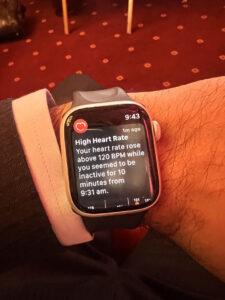
I wasn’t fearful of the stage. I was excited. But my Apple Watch couldn’t tell the difference. Sometimes even we can’t tell the difference when our bodies behave a certain way. Is my heart racing because I have a fear of public speaking, or am I simply experiencing a very natural adrenaline rush?
It is possible to go from being fearful to being excited to speak in public. And the way to do it depends on when you have to speak.
If you tell me you are about to go on stage in 10 minutes and feel fearful, I would say, take three very deep breaths. Inhale through the nose, let the air fill your lungs and exhale through your mouth. This will physically calm you down. Have a sip of water. Check your facial expression. Is it a frown or a smile? Needless to say, make sure it is a smile. Some coaches recommend mild movement to manage the adrenaline. All these things can help manage the symptoms, like a racing heart, sweaty palms, or a dry mouth.
The most important thing you can do is remind yourself that you are there to serve, not perform. You are there to give something to the audience, not take something from them. You are there to have a conversation, not deliver something perfect. In other words, you can get into the right state of mind.
Now, if you have a week to go until you have to speak, instead of 10 minutes, the physical symptoms won’t be there. Your heart is unlikely to be racing. But if you still feel fearful about speaking in public, then maybe the fear really is real. But we have time. It can be overcome.
With a week to go, the focus should be on preparation. What’s the structure of your presentation? Memorising is not recommended, but having a structure and knowing what your main messages are is highly recommended. How will you start and finish? Do you know the exact first and final words you will say? These can be rehearsed. Many speakers feel comfortable once they get into their material. And so, a rehearsed opening is not only important for captivating the audience, it is also important for settling nerves.
And that preparation can be extended further. If you are using slides, do you have a good set of slides? Have you got the right amount of material for the time allocation you have? Preparation at this stage means having a clear structure for your speaking engagement and rehearsing it so you know the plan.
Now, if your speaking engagement is months away, or you are just generally thinking about public speaking and still feel fearful, this is where things get really interesting. Now, you enter the realm of developing skills.
At this point, it is important to make a clarification. Some people want to become confident public speakers. Confidence, in my view, cannot be taught or developed. It is simply a by-product of having skills. Does Lionel Messi feel confident when he steps onto a football pitch? Does Adele feel confident when she steps onto a stage? I would imagine so, but not because they developed confidence. It is because Messi developed football skills and Adele developed singing skills. They can be confident that they will deliver, even if their hearts are racing. Like I was when I was about to take the stage in Stockholm. The only difference being that I am nowhere near as awesome or rich as Messi and Adele.
And so, you develop public speaking skills. Storytelling, the art of using your voice, the power of connecting through body language, humour and engagement, crafting compelling narratives and messages, and so forth. And give yourself some exposure therapy. Try these skills when talking to friends. That, too, is public speaking.
Making a story engaging when narrating it to a group of friends means developing the exact storytelling skill you need when narrating a story in a business presentation. Over time, skills become part of your muscle memory, so that varying the pitch or cadence of your voice, using illustrative gestures or sharing a personal story in the present tense becomes second nature.
That is how you overcome the fear of public speaking. Next time you see someone speaking like they own the stage, know that their heart might be racing, their palms might be sweaty and their mouth might be dry, but they are still speaking with confidence because they have spent years building and polishing their skills and have put themselves in situations where those skills can be tested. Just like an athlete. Just like a singer.